What is a Fabric Port? Simplifying network access

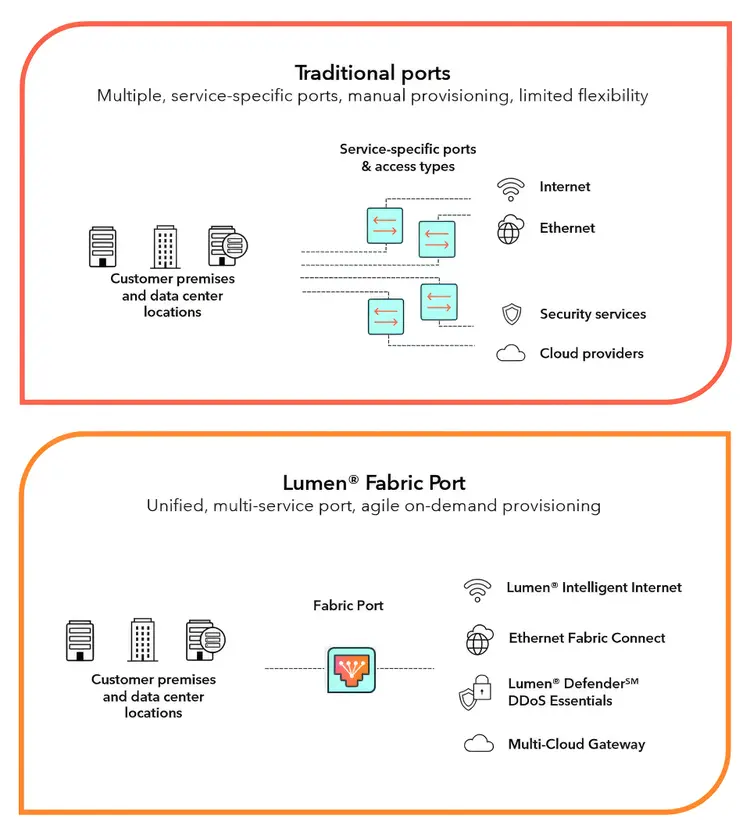
Ports are the physical connection point between a customer’s equipment and a provider’s network, and UNIs (User Network Interfaces) have been the primary port technology since the early 2000s. Meanwhile, enterprise networking has increasingly shifted to software-defined solutions, providing flexibility in both delivery and consumption. However, ports have primarily remained static, meaning separate ports for each service or cloud on-ramp, which can create architecture sprawl and complexity.
Lumen® Fabric Port is our answer to the dissonance between increasingly dynamic networks being held back by persistently static physical access infrastructure, helping to simplify connectivity with a programmable, agile port.
What is Fabric Port?
Lumen Fabric Port is a programmable multiservice access point that connects a customer location to the Lumen Network. It supports internet, Ethernet, multicloud and network-level security services through a common port, with digital visibility and management through Lumen Connect®.
Fabric Port transforms the port from a passive, rigid network component into an agile access foundation that can adapt as applications, cloud strategies and bandwidth demands evolve.
How is Fabric Port different from other multiservice ports?
Some connectivity providers have been offering multiservice ports for some time now, meaning more than one service can be supported on a single physical port. The problem is that most remain restrictive. Often these multiservice ports support only predefined service combinations packaged as bundles. This may be helpful in terms of speeding up initial provisioning, but what happens if needs change? Organizations may be stuck with another rigid piece of architecture that doesn’t adapt, resulting in infrastructure sprawl, greater operational burden and slower future deployments.
Fabric Port doesn’t define what multiservice must look like for organizations. One Fabric Port can replace several service-specific ports and enable internet, Ethernet, multicloud and network-level security services through a single physical connection. Rather than pre-defined offerings, services on the port are determined by the customer’s needs. Because the port itself is programmable, those services can change without redesigning the network each time requirements change.*
What does port programmability really mean?
Network-as-a-Service (NaaS) models introduced network programmability to a traditionally static network consumption model, enabling enterprises to adjust bandwidth based on changing needs. With NaaS, the industry has proven that static doesn’t necessarily equal performance predictability. On-demand connectivity can deliver high-capacity, low-latency performance with software-defined control, automation and near-real-time adaptability. Traditional ports may support flexible bandwidth, but service changes often require rearchitecting the network.
With Fabric Port, we extend that flexibility to the port itself. Because Fabric Ports are service agnostic, they can support internet, Ethernet, multicloud or security services over the same physical connection. Services can be provisioned, adjusted or reassigned without changing the underlying infrastructure. For customers, this means flexibility to choose which services meet their needs—helping limit architectural sprawl while making it easy to adjust services on the same physical port as requirements evolve.
Fabric Port delivers agility, but keeps it simple
The shift to on-demand networking can feel disruptive for customers used to consuming their services in a static model. Let’s break down some common concerns and how Lumen helps solve enterprise networking challenges with Fabric Port as the programmable access foundation.
Will port programmability lead to variability in my network performance?
A network that can change on demand gives you control over your network strategy. Without compromising on performance, Fabric Port gives you the autonomy to adapt services and adjust bandwidth entirely based on your needs. We own the infrastructure end to end, delivering consistent performance, control and strong SLAs you can count on.
Does consolidating my network infrastructure limit my ability to scale across locations or clouds?
Consolidating network infrastructure can help provide flexibility for growth. Single-service ports can contribute to physical architecture sprawl, potentially increasing hardware costs and operational complexity as services are added. That’s where a multiservice port can help by consolidating access to multiple services through a programmable foundation that can scale with changing needs. As the foundation for Lumen NaaS services, Fabric Ports deliver up to 100 Gbps internet, Ethernet and multicloud solutions across more than 10 million locations.
Won’t API and portal-based services place more network management responsibility on my already busy teams?
For many organizations, overseeing multiple services can mean coordinating multiple vendors and portals, increasing the operational burden for network teams. With Fabric Port, all supported services can be accessed through a single digital platform, Lumen Connect®. Teams don’t need to switch portals or platforms to view service activity, billing, ticketing or support, helping to minimize service management complexity.
Put simply, Lumen Fabric Port replaces multiple service-specific ports with one programmable port, so you can add or change services without adding complexity. View the data sheet to see how it works, or learn how Lumen NaaS puts that flexibility to work.
*Some services may require full dedication of the port’s bandwidth.
This content is provided for informational purposes only and may require additional research and substantiation by the end user. In addition, the information is provided “as is” without any warranty or condition of any kind, either express or implied. Use of this information is at the end user’s own risk. Lumen does not warrant that the information will meet the end user’s requirements or that the implementation or usage of this information will result in the desired outcome of the end user. All third-party company and product or service names referenced in this article are for identification purposes only and do not imply endorsement or affiliation with Lumen. © 2026 Lumen Technologies. All Rights Reserved

Related resources