Quantum readiness for government agencies has a deadline. It just isn't Q Day.

In October, the Lumen public sector team and key customers gathered at the High-Performance Network (HPN) Summit to discuss today’s most pressing public sector topics. Sessions covered AI-enabled network operations, resilient infrastructure and route diversity, programmable networking, cybersecurity and threat intelligence, and supply-chain security.
By the afternoon session, the conversation had already covered a lot of ground. Then, Lumen principal product manager for public sector Thomas Broadwell took the stage to talk about post-quantum security.
His goal wasn’t to add another date to the calendar or another warning to the headlines. It was to shift the question. Instead of asking “When will quantum break today’s cryptography?” he asked the room to consider whether their organizations are operationally prepared to transition.
The questions that followed, from implementation complexity to ownership, interoperability and supplier readiness, pointed to something agencies can and must act on today.
Why government agencies can't wait for a date to get quantum-ready
For government agencies, preparing for the quantum era can feel like preparing for an event without a fixed date. "Q Day" is the point when a quantum computer becomes powerful enough to break the public-key cryptography widely used today. But focusing on when quantum computing could challenge today’s cryptography can distract from a more immediate question: is your organization prepared to adapt when the cryptography protecting the mission needs to change?
Quantum readiness is about more than moving from one encryption algorithm to another. It starts with understanding where cryptography exists today, what it protects and how changes can be made while supporting continuity of critical operations.
In 2024, the National Institute of Standards and Technology (NIST) finalized three post-quantum cryptography standards covering quantum-resistant key establishment and digital signatures. NIST says these standards are ready to be implemented and recommends that organizations begin identifying where vulnerable algorithms are used and planning to replace or update them.
The standards define the new cryptographic algorithms, but adopting them requires a broader migration effort. NIST, the Cybersecurity & Infrastructure Security Agency (CISA) and the National Security Agency (NSA) recommend that organizations build quantum-readiness roadmaps, conduct cryptographic inventories, assess risk and engage technology vendors. Four practices help translate that guidance into practical starting points for government agencies:
- Protect what matters most.
- Build a cryptographic inventory.
- Plan migration around the mission.
- Build for ongoing change through crypto agility.
Start quantum readiness with what needs protection
One concern shaping the quantum conversation is commonly called “harvest now, decrypt later.” Encrypted information can potentially be collected today and retained in hopes that future quantum capabilities will allow it to be decrypted.
CISA, NIST and the NSA specifically identify this risk when explaining why organizations should prepare now, particularly when information has a long secrecy lifetime. Their joint quantum-readiness guidance recommends early planning, including creating migration roadmaps, conducting cryptographic inventories, performing risk assessments and engaging vendors.
That changes the starting point for quantum readiness.
Instead of focusing only on forecasts for Q Day, government organizations can consider how long their information must remain protected and the potential mission impact if it were exposed. Some information may lose its value quickly. Other information associated with government operations, critical infrastructure or mission systems may need protection for years.
The longer information remains sensitive, the more important it becomes to understand the cryptography protecting it today.
Build a cryptographic inventory to see where cryptography lives
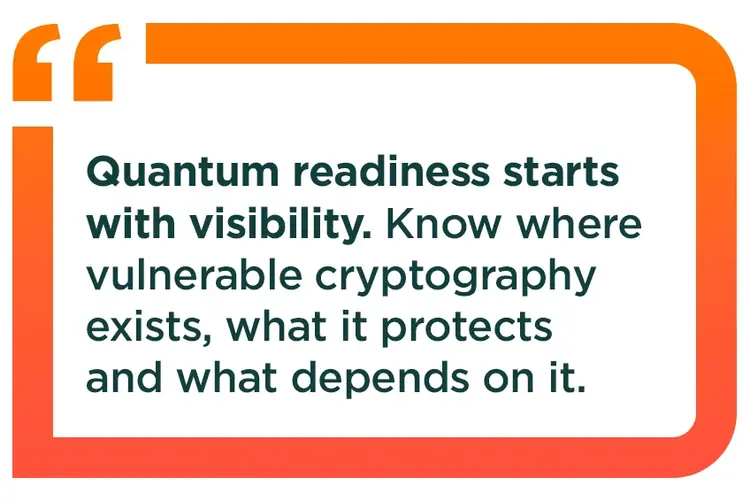
You can’t prioritize cryptographic risk if you don’t know where vulnerable cryptography exists.
That makes cryptographic discovery and inventory an important part of quantum readiness. NIST’s National Cybersecurity Center of Excellence says migration requires understanding the use of quantum-vulnerable public-key algorithms across hardware, software and services and developing roadmaps that prioritize implementation of NIST’s post-quantum cryptographic algorithms. Its migration initiative is also exploring how cryptographic inventories can support risk management and prioritization decisions.
CISA is taking a similar approach across federal civilian agencies. Its strategy for automated cryptography discovery and inventory tools is designed to support agencies in identifying information systems and assets that contain cryptography vulnerable to cryptographically relevant quantum computers.
But discovery alone isn’t enough. Organizations also need context around what a cryptographic dependency protects and which systems, technologies and suppliers could be affected by a change. Those relationships can help turn technical inventory information into actionable migration priorities.
Plan post-quantum migration around the mission
Government organizations rarely have the luxury of rebuilding technology environments from scratch. They may operate long-lived mission systems alongside newer infrastructure while navigating supplier dependencies and complex technology environments.
Migration also extends beyond the systems an agency directly manages. Post-quantum capabilities are beginning to emerge across the broader technology ecosystem, reinforcing the need to understand not only cryptographic assets, but also the platforms, software and suppliers they depend on.
And the migration timeline is no longer entirely theoretical. NIST’s current transition timeline calls for quantum-vulnerable algorithms to be deprecated and ultimately removed from its standards by 2035, with high-risk systems transitioning significantly earlier.
That creates a tangible planning horizon while reinforcing the need to prioritize based on risk rather than trying to predict precisely when a cryptographically relevant quantum computer will arrive.
CISA, NIST and NSA recommend organizations begin with a quantum-readiness roadmap that incorporates cryptographic discovery, inventory, risk assessment and analysis, and vendor engagement.
Instead of asking “What cryptography should we replace?” agencies can ask “What should we address first based on mission risk and our ability to make that change responsibly?”
That distinction matters. A migration strategy needs to account not only for cryptographic vulnerabilities but also for the operational dependencies surrounding them.
Build for change with crypto agility
Post-quantum migration isn’t likely to be the last time government organizations need to change cryptography.
NIST’s migration work is already looking beyond algorithm selection to practical implementation challenges. Its National Cybersecurity Center of Excellence initiative includes cryptographic discovery as well as interoperability testing intended to identify and resolve compatibility issues in controlled, non-production environments.
That supports a broader principle raised during the HPN discussion: crypto agility. Rather than treating post-quantum migration solely as a one-time replacement effort, organizations can work toward a greater ability to identify, govern, test and change cryptographic controls as requirements evolve. We explore the implications of that approach for mission environments further in Quantum readiness is an architecture decision for homeland defense.
Seen through that lens, quantum readiness becomes less about predicting a specific point in time and more about building adaptability into the infrastructure supporting the mission. Whenever Q Day arrives, agencies that have prepared will be able to update their cryptography and keep the mission moving.
For another perspective on how post-quantum cryptography is moving from standards into the technologies organizations use every day, read Thomas Broadwell’s PQC Daily Brief: “The largest cryptographic change ever,” and the plumbing gets an upgrade. He also shares his thoughts on post-quantum developments every day on LinkedIn, so check in often to keep up with how quickly this space is moving.
Take the next step toward quantum readiness. Explore how Lumen works with government agencies to modernize the infrastructure supporting critical missions.
This content is provided for informational purposes only and may require additional research and substantiation by the end user. In addition, the information is provided "as is" without any warranty or condition of any kind, either express or implied. Use of this information is at the end user's own risk. Lumen does not warrant that the information will meet the end user's requirements or that the implementation or usage of this information will result in the desired outcome of the end user. All third-party company and product or service names referenced in this article are for identification purposes only and do not imply endorsement or affiliation with Lumen. This document represents Lumen products and offerings as of the date of issue. Services not available everywhere. Lumen may change or cancel products and services or substitute similar products and services at its sole discretion without notice. © 2026 Lumen Technologies. All Rights Reserved.

Related resources